
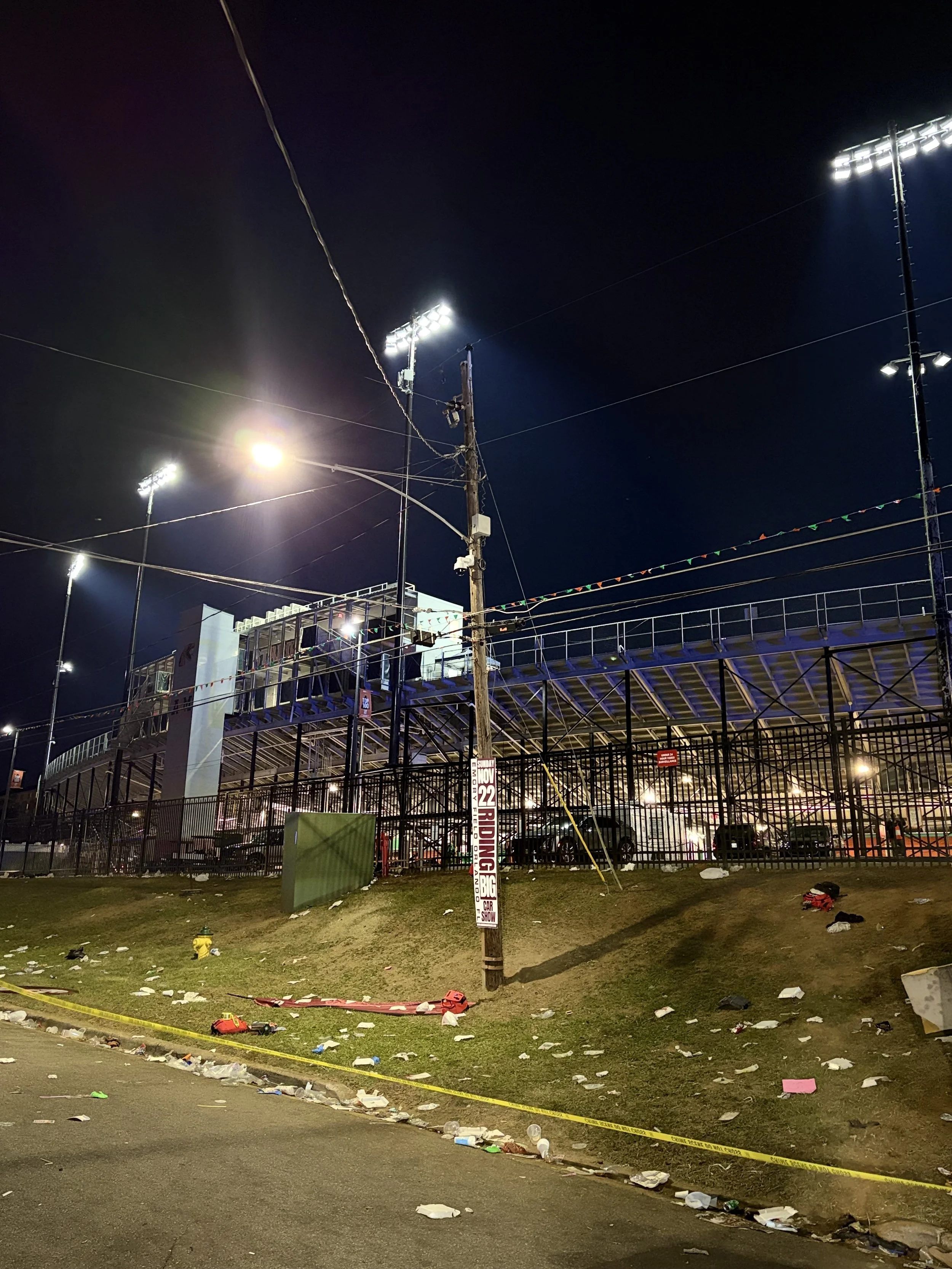
An encounter with gun violence on Perry Street left me questioning the standards we're willing to uphold, the behavior we're willing to excuse, and the future we're leaving our children.
By Justin Hill
POP! POP! POP! POP! POP! POP! POP! POP! POP! POP! POP!
Gunfire.
I immediately began running toward it. People rushed past me in the opposite direction as I reached for my gun and began pulling it from its holster. Another officer running alongside me yelled, "You want to stay together?"
"Yeah!"
The police radio erupted with officers reporting people down. The descriptions were gruesome, and each transmission added to the uncertainty of what we were running toward. We knew people were hurt, but we didn't know how many, whether the shooter was still nearby, or what we might encounter.
I had just finished working security inside Bragg Memorial Stadium during FAMU Homecoming and had been reassigned to Perry Street to help prevent trouble. Anyone familiar with Homecoming knows the challenges this area has presented over the years.
But what disturbed me most wasn't the gunfire. It was what happened afterward.
While children and adults ran for safety, an unsettling number of people simply stood around. Some who initially fled appeared to be returning, seemingly convinced the danger had passed. Their attention turned toward the injured, and what should have remained an emergency began attracting an audience.
"GET OUT OF HERE! MOVE!"
I screamed until my voice cracked. Officers were trying to secure the scene, and emergency medical personnel needed a safe environment to reach the wounded. Yet people continued standing around, watching the commotion.
"THE AMBULANCE ISN'T COMING UNLESS Y'ALL LEAVE!"
I looked people directly in their eyes, desperately trying to communicate the urgency of what was happening. Some seemed annoyed by my instructions. I found myself cursing at adults and repeatedly telling young girls with phones in their hands to run.
Imagine having to convince children to leave an area where someone has just opened fire.
I understand people respond differently to fear and confusion. Some freeze, while others struggle to process what they're witnessing. But what I saw appeared to go beyond that.
It felt like a matinee, a gruesome production with free admission. People seemed determined to watch others experience some of the worst moments of their lives.
The audience wasn't leaving, and there would be no refund.
The price of admission was somebody else's suffering.
In the hours afterward, I began wondering whether repeated exposure to violence has made some of us frighteningly comfortable with it. Our children grow up watching fights, shootings, and humiliation circulate through social media as entertainment. Someone's suffering becomes content, and the audience moves on to the next video.
I wonder what happens when that same audience encounters actual suffering and struggles to recognize the difference.
Saturday night's shooting injured twelve people, eleven by gunfire. Six of the injured were juveniles, the youngest just eleven years old.
On Sunday, the Tallahassee Police Department arrested Anthony Rivers III, a fifteen-year-old accused of firing the shots. He faces eleven counts of attempted second-degree murder. Investigators believe none of the victims were intended targets.
A child stands accused of shooting into a crowd and injuring other children.
I've struggled with that reality, particularly as conversations about the accused teenager's upbringing and parents have begun circulating throughout our community.
I don't know everything about the circumstances in which he was raised, and I cannot claim his father's absence or family history caused the alleged shooting. But I believe the conversation about parental responsibility is unavoidable.
I grew up with divorced parents. My mother and father didn't remain together, but both made a conscious effort to raise me and my siblings. Their relationship ended, yet their responsibilities to us continued. They provided a foundation that eventually helped me recognize when it was time to grow up, establish standards for myself, and prepare for the responsibilities of adulthood.
Today, I'm a husband and father because I made choices that helped prepare me for those roles. I'm far from perfect, but I understand my decisions no longer affect only me.
A father's responsibility lasts a lifetime.
A man can make terrible decisions and eventually become a better person. We should welcome that growth. But turning your life around doesn't erase the consequences of earlier choices, particularly when children have spent years living with them.
Fatherhood requires more than bringing a child into the world. It requires the willingness to provide guidance, establish boundaries, and remain accountable even when life becomes difficult.
And that responsibility belongs to mothers, too.
I'm tired of conversations in which accountability gets buried beneath explanations for destructive behavior. Understanding someone's circumstances is important, but understanding shouldn't automatically become an excuse.
We will never eliminate mistakes, poor decisions, or criminal behavior. Those problems aren't exclusive to Black people or any other community. What matters is how we respond, what standards we uphold, and whether we're willing to apply those standards even when doing so makes us uncomfortable.
I think that's what angered me most on Perry Street.
I wasn't watching children alone behave irresponsibly. I was watching adults who appeared unwilling to accept even the simplest responsibility during an emergency. I needed them to move so injured people could receive help, and some seemed more interested in watching.
We cannot expect children to grow into responsible adults when the adults around them refuse to demonstrate responsibility themselves.
This is particularly painful because Saturday was supposed to celebrate FAMU Homecoming, an occasion representing generations of Black education, achievement, family, and tradition. Thousands of people came together for those reasons, yet their celebration has been overshadowed by violence.
Black culture is far larger than the destructive behavior that so often dominates its public image. I see its beauty in the fathers, families, young athletes, and community members I photograph through BlackDad.
But loving our culture shouldn't require defending everything happening within it.
No individual, regardless of who they are or where they come from, should become more important than the standards we establish for our community's future.
We should be able to support someone's rehabilitation without excusing their actions. We should be able to acknowledge hardship without abandoning accountability. And we should care enough about our children to place their futures above our loyalty to people whose behavior threatens those futures.
I wish I knew exactly how to accomplish that.
After the initial chaos Saturday night, I found myself looking at blood left in the grass. It had come from a child's head.
I thought about the injured children, the families receiving devastating news, and the people who had stood watching while we desperately tried to help.
I remembered screaming until my voice cracked, trying to convince people to do something as simple as move.
And I realized how closely that experience resembled the conversations we've been having about violence in our communities for years.
People have been sounding the alarm, asking us to take responsibility and warning us about the future we're creating for our children.
Yet we keep finding ourselves in the same circumstances.
I don't believe another article will suddenly change everything. I don't have a solution capable of correcting generations of harmful behavior, and I won't pretend otherwise.
But I know we cannot continue placing individual loyalties, personal excuses, and temporary comforts above the futures of our children.
I spent Saturday night yelling for people to move because lives depended on it.
Now I'm wondering what it will take for us to move as a community.
The crowd eventually disappeared, and the shouting stopped.
The blood was still there.
And I cannot bring myself to be comfortable with that.
BlackDad | Fathers lead. Children rise. Legacies last.